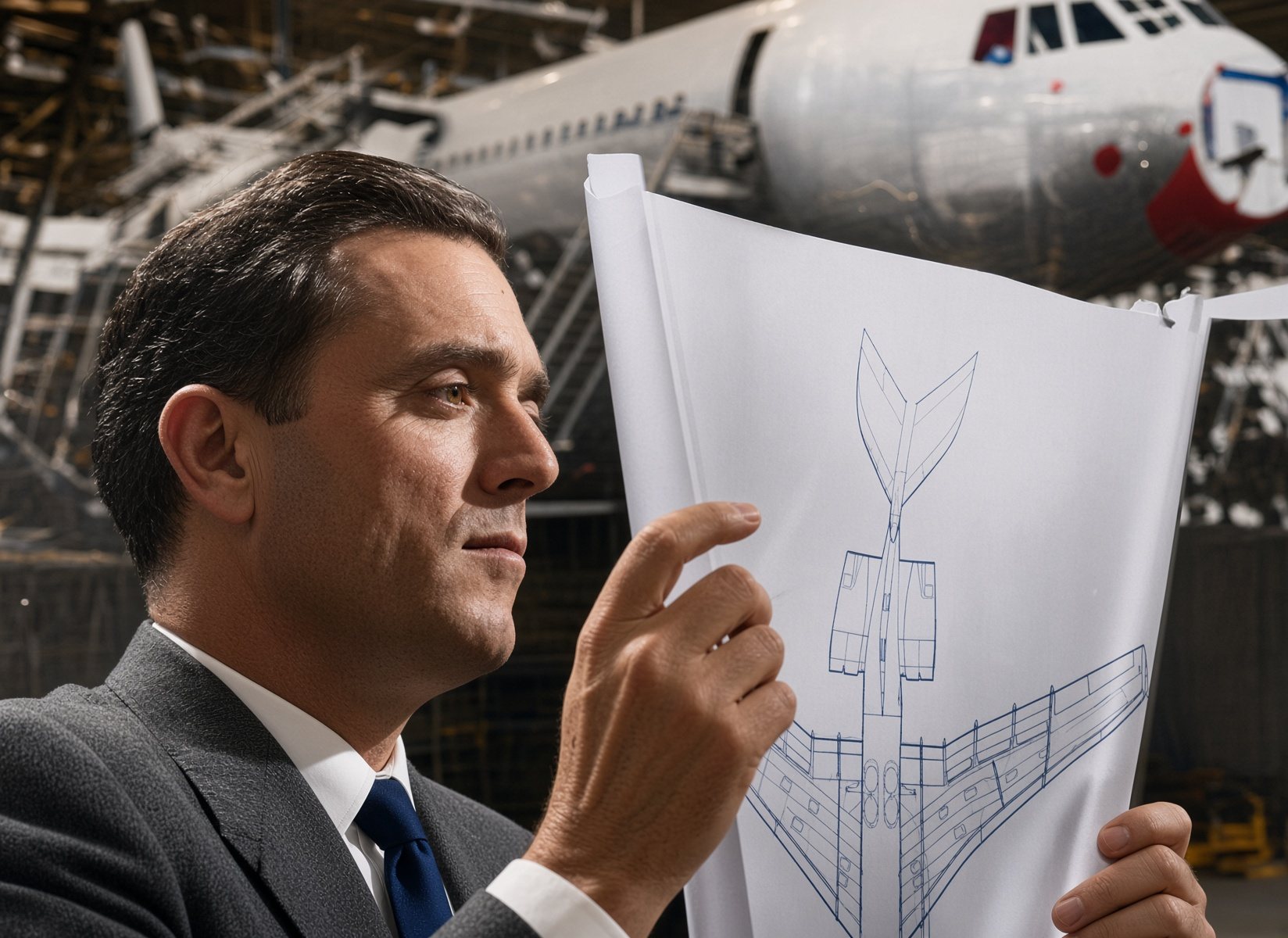
Maurice Oliver Wilmer
Fuselage project manager · Vickers VC10
ScrollVickers-Armstrongs (Aircraft) Ltd · Weybridge · 1962
VC10
“An aircraft is made of a million components, all supplied by the cheapest bidder.”
Maurice Oliver Wilmer
The Vickers VC10, taken apart one system at a time. Made for Maurice Oliver Wilmer, fuselage project manager on the aeroplane, who patented a door that the cabin itself holds shut.
01 · General arrangement
The whole aeroplane
The VC10 was drawn for BOAC’s routes into Africa and Asia, where runways were short and airfields hot and high. Four Rolls-Royce Conways sit at the tail, which leaves the whole wing free to make lift.
It first flew from Brooklands on 29 June 1962 and entered BOAC service on 29 April 1964, London to Lagos.
- Length
- 158 ft 8 in48.36 m
- Span
- 146 ft 2 in44.55 m
- Height
- 39 ft 6 in12.04 m
- Max take-off
- 312,000 lb141,521 kg
02 · Fuselage
Maurice’s department
A pressurised light-alloy tube built as a fail-safe semi-monocoque: frames for the hoops, stringers running fore and aft, and skin over both. More than half the structure’s weight was machined from solid metal, with skin and stringers cut from one billet.
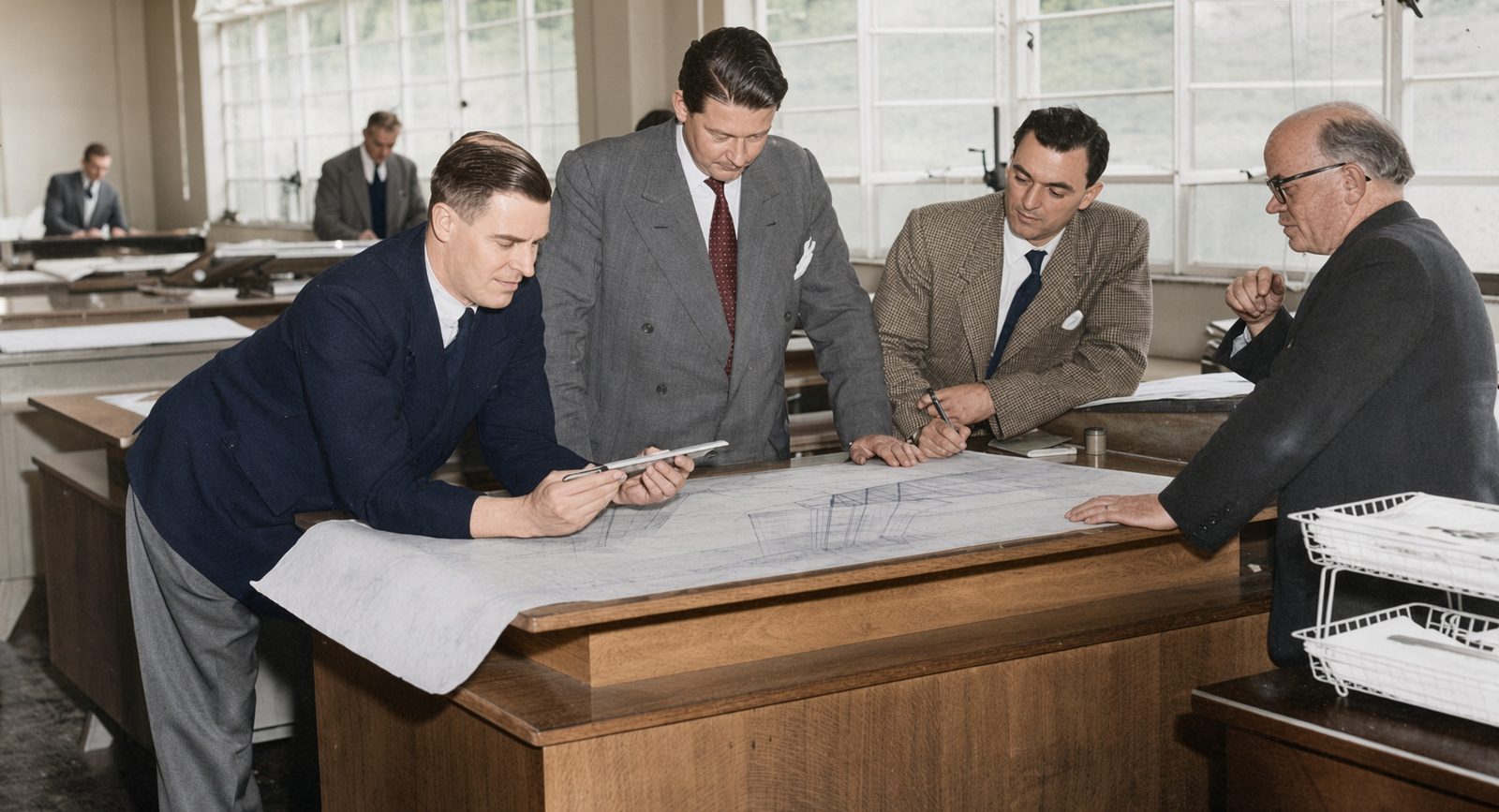
The cross-section is a double lobe faired to an oval. Maurice Wilmer was fuselage project manager on the engineering team that designed it.
- External width
- 12 ft 4 in3.76 m
- External height
- 14 ft 1½ in4.31 m
- Cabin width
- 11 ft 6 in3.50 m
- Cabin length
- 92 ft 4 in28.14 m
03 · The door
Maurice’s door
In July 1958, with the VC10 on the drawing boards at Weybridge, Maurice filed a patent for a passenger door that cabin pressure holds shut. The skin is drawn as glass here so you can see how it works.
Filed in Britain 4 July 1958 · Granted 17 October 1961
04 · The door
Held shut by the cabin
The door is a plug. Lugs machined into its edges sit just inside matching lugs on the door frame.
In flight, the cabin pushes outward on the door with a force of several tons. All of it goes through the lugs and into the airframe, not through a latch. The harder the cabin pushes, the harder the door is held.
05 · The door
Unlocking
Push the handle down and two feet extend from the bottom of the door. They press on the sill and lift the whole door, with springs helping, until its lugs line up with the gaps between the frame’s lugs.
While the cabin is pressurised, friction between the lug faces stops the door lifting. It stays shut even if its bolts fail to engage.
06 · The door
Parallel motion
Once the lugs are clear, the door swings outward on its hinge arm. A second link keeps it parallel to the fuselage the whole way, so it never twists in the doorway.
53 later patents cite Maurice’s, among them door designs from Boeing and Airbus.
07 · Wing
A clean wing
With nothing hung underneath, the wing could be given over to lift. Four slat sections run along each leading edge, five Fowler flap sections slide out of the trailing edge, and three spoilers on top double as air brakes.
The curved Küchemann tips were added after flight tests found too much drag. Inside, the torsion box is also the fuel tank.
- Sweep, ¼ chord
- 32° 30′
- Wing area
- 2,851 sq ft264.9 m²
- Thickness
- 13% root9% at the tip
- Fuel
- 17,925 galimperial, all tanks
08 · Flying controls
Eleven surfaces, eleven motors
Every control surface is split: four aileron sections, four elevator sections, three rudder sections. Each section has its own Boulton Paul powered flying control unit, a small self-contained hydraulic system with an electric pump and reservoir.
Lose one unit and the other sections carry on. The whole tailplane moves to trim, driven through a screw jack by two hydraulic motors.
09 · Powerplant
How a Conway breathes
Air enters the intake and splits. Some flows round the outside of the engine as bypass air. The rest is squeezed by the low- and high-pressure compressors, burned with fuel in the combustion chambers, and pushed out through the turbines that drive the compressors.
The Conway was the first turbofan, or bypass engine, to go into airline service.
- Engines
- 4 × ConwayRolls-Royce RCo.42
- Bypass ratio
- ≈ 0.6bypass air to core air
10 · Powerplant
Four at the back
Each Conway gives about 21,000 lb of thrust. They hang in pairs from a torque box on either side of the rear fuselage.
Mounted high and aft, they stay clear of stones thrown up on rough strips and put their noise behind the passengers. The “beaver tail” fairings between the jet pipes were another cure found in flight test.
11 · Empennage
The T-tail
The tailplane sits on top of the fin, well clear of the engine exhaust, with a bullet fairing where the two meet. Its span is 43 ft 10 in.
On the Super VC10 the fin itself became a fuel tank, carrying another 1,350 gallons.
12 · Landing gear
Built for rough strips
Two four-wheel main bogies retract inward and a twin-wheel nose leg retracts forward. Wide, low-pressure tyres spread the load across the weaker runways of the Empire routes.
From selector to locked up took about nine and a half seconds.
- Wheels
- 108 main, 2 nose
- Wheelbase
- 65 ft 11 in20.09 m
13 · Cabin
The quiet cabin
With the engines behind them, passengers sat in one of the quietest cabins of the jet age. BOAC filled its VC10s better than any other type in its fleet.
BOAC’s Standards were fitted for 109 in two classes; six-abreast, the cabin could take 151. Four crew sat on the flight deck.
14 · Complete breakdown
One million components
Nobody has published a proper count for the VC10, so his figure stands. This model manages a few hundred. The rest were rivets, fasteners and brackets, every one of them from somebody’s cheapest quote.
“Flying is falling with style.”
Maurice Oliver Wilmer
Put it all back together and it flies. A VC10 crossed the Atlantic in 5 hours 1 minute, the fastest subsonic crossing by an airliner for 41 years.
Fifty-four were built. The Royal Air Force flew the last of them until 20 September 2013.
Dedication
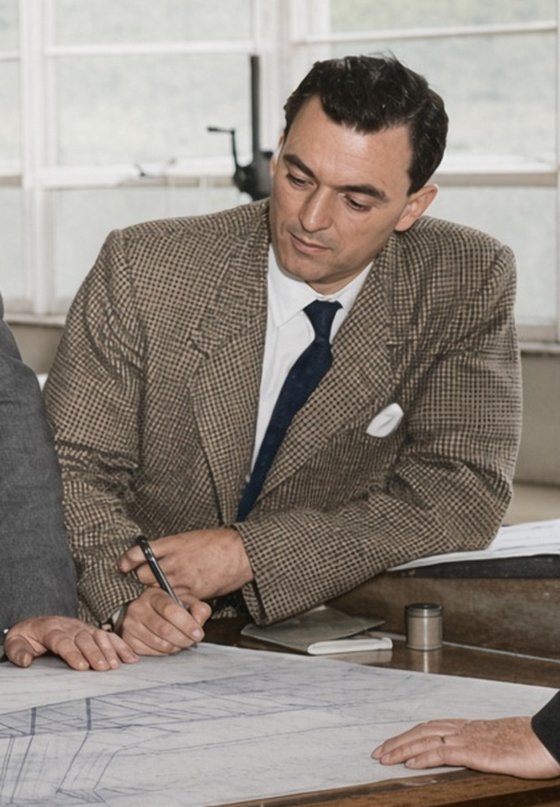
Maurice Oliver Wilmer
Fuselage project manager, VC10 engineering team, Vickers-Armstrongs (Aircraft) Ltd, Weybridge. Inventor, US patent 3,004,303.
Made for him by his grandson, Rory Wilmer.
The model is simplified from published figures for the Standard VC10, Type 1101. Sources: US 3,004,303, vc10.net, Brooklands Museum, Wikipedia.